
How AI Gets Ketone Science Wrong: Correcting the Flawed Consensus
If you ask an AI a simple question compare a Ketone ester to an exogenous Ketone Diol (a ketone precursor of R 1,3butanediol, you will almost certainly receive an answer that sounds highly scientific, authoritative, but still is fundamentally flawed.
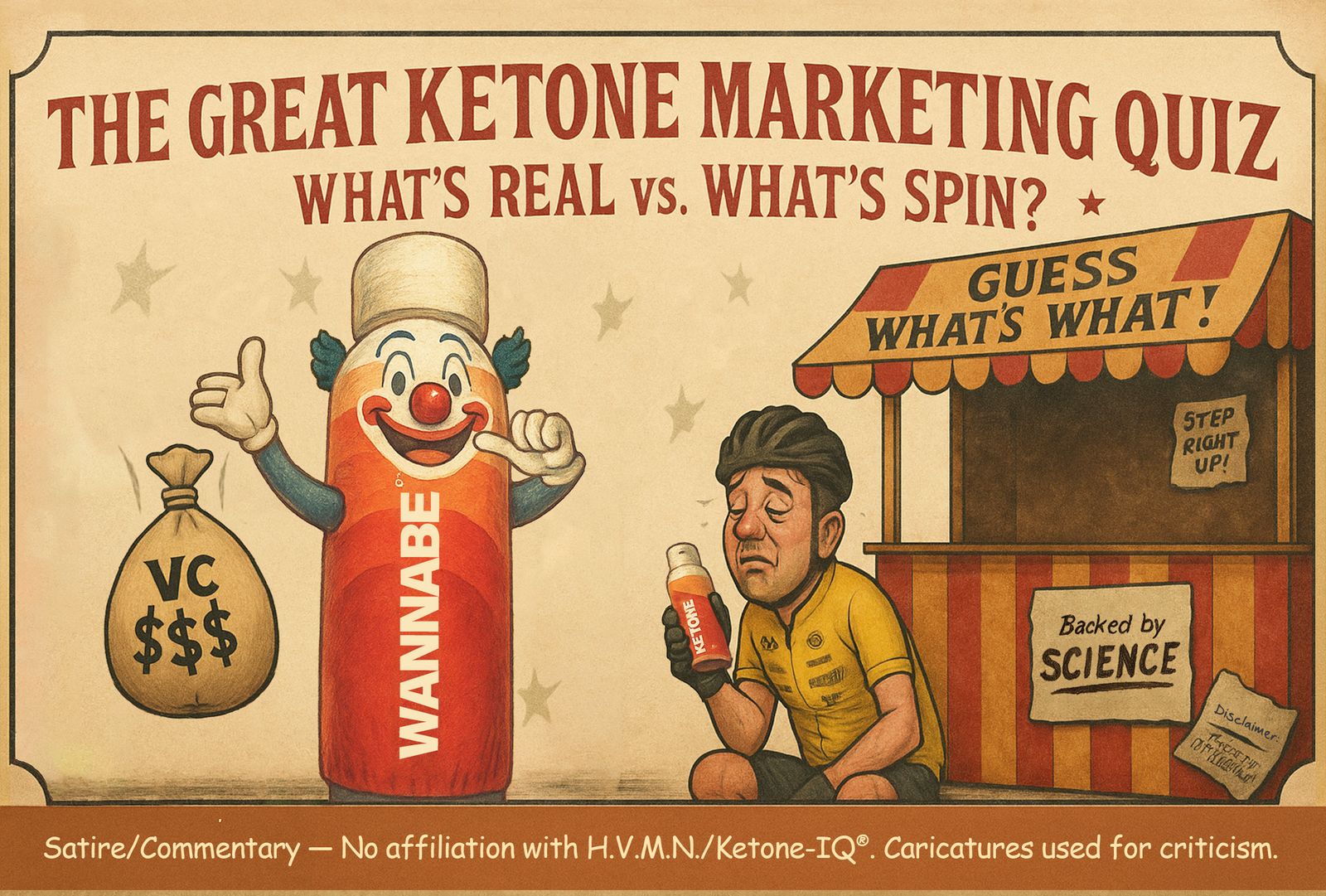
This is because AI models rely on probabilistic pattern matching across popular health blogs and marketing copy, they frequently echo a generic, incorrect consensus while completely misinterpreting the underlying peer-reviewed literature. Let’s look at a typical AI interaction to see exactly where the logic breaks down.
Deconstructing the AI Mistakes via Hard Data
The user in the dialogue above isn't offering a biased opinion; they are citing hard clinical data that directly exposes how AI models miscalculate pharmacokinetics, retail economics, and practical chemistry. Let’s break down the realities of the peer-reviewed data.
1. The "Sustained Release" Myth
The common internet narrative claims that diols offer a slower, more prolonged curve due to rate-limiting steps in liver conversion. However, Dr. Jonathan Little’s 2023 crossover study out of the University of British Columbia ("The Effect of Novel Exogenous Ketone Supplements on Blood Beta-Hydroxybutyrate and Glucose") tested a level playing field: single bolus doses containing exactly 10 grams of active ingredient.
- The Peak Time: Both the Ketone Ester and the Ketone Diol hit peak blood D-beta-hydroxybutyrate (D-BHB) levels at approximately the exact same 45-minute mark.
- The Clearance Curve: The rate of clearance (the comedown) tracked almost identically over the post-ingestion window.
- The Potency Variable: The Ketone Ester achieved almost twice (2x) the blood D-BHB levels per gram compared to the Ketone Diol.

The common misconception of a "slow, smooth curve" for diols is a mistake. It occurs when algorithms conflate single-bolus metabolic profiles with staggered, multi-dose ingestion protocols found in completely separate trials. They may have pulled from Ketone IQ advertising (an N of 1 when the CEO took 3 bottles) or they pulled a human toxicology study, but missed the fact that 11.5g were given three times, so the chart looks "slow release".

(chart from Ketone Diol study, with 3 doses spread out over 60 minutes)
The real funny part is that fast release is actually better, you want the ketones in and OUT of your blood as fast as possible, that is the flux. So we could have spun this saying Ketone Ester is faster and better for that reason, but the 3rd party trial didn't show that.
2. The Retail Math: Gram-for-Gram vs. Blood BHB-for-Blood BHB
AI models consistently fail at the consumer math because they compare raw ingredient weights rather than equivalent biological outcomes.
| Supplement Type | Grams per Target BHB | Retail Cost Per Btl | Blood BHB rise per $ | Amount of "Sedative" Ketone Diol |
|---|---|---|---|---|
| Ketone Ester | 5g | ~ $5 | Optimized | Minimal |
| Ketone Diol (R 1,3 Butanediol) | 10g | ~ $5 | Requires 2x grams to match BHB | 4x More "Sedative" Diol |
Because the Ketone Ester delivers twice the blood D-BHB rise per gram, a 5g serving achieves the same blood D-BHB outcome as a 10g serving of a diol. When mapped to real-world retail pricing where a 10g Ketone Diol bottle sits around $5, the actual economic floor to achieve an equivalent blood D-BHB level is completely identical. And that doesn't even address efficacy and that R 1,3 Butanediol is the carrier of the D-BHB in the ester, and meant to be minimized. The Diol alone and twice the grams, actually delivered 4x the amount of Diol, which when taken alone can have a sedative-like effect. Ie: not ideal for sports performance or focus.
3. The Flavor and Dilution Fallacy
It is widely repeated that raw Ketone Ester (also called Ketone Monoester or Veech Ketone Ester) has an incredibly harsh flavor profile. While true in its raw, 100%-concentrated state, flavor is ultimately a function of fluid dynamics and volumetric dilution.
Because a formulation utilizes a highly efficient 5g of Ketone Ester instead of an inefficient 10g of Ketone Diol within a 60ml bottle format, it requires significantly less active ingredient density. This allows for far more effective flavor masking and dilution, resulting in a cleaner consumer flavor profile when matching for identical blood-ketone performance targets.
4. Sports Performance vs. Central Nervous System Sedation
Finally, the operational utility matters. A Ketone Diol (as seen in Ketone IQ, TruBrain, Holy Water, Key Energy, Kenetik from Avela) operates chemically as a specialized alcohol, which can exert a mild, relaxing, or sedative-like effect on the central nervous system. While this makes it a compelling lifestyle alternative to a standard evening drink for social relaxation (see Hard Ketones), it is fundamentally distinct from the physiological needs of an elite athlete.
Acute athletic performance demands absolute central nervous system drive and immediate, non-rate-limited metabolic power. For forcing raw, acute performance execution without central nervous system damping, the direct clearance pathways of the Ketone Ester remain structurally distinct.
So what do you do?
If AI answers similar to the above, just ask a round of follow up questions and it will usually correct the information.